

 Together Business Is Made Easier
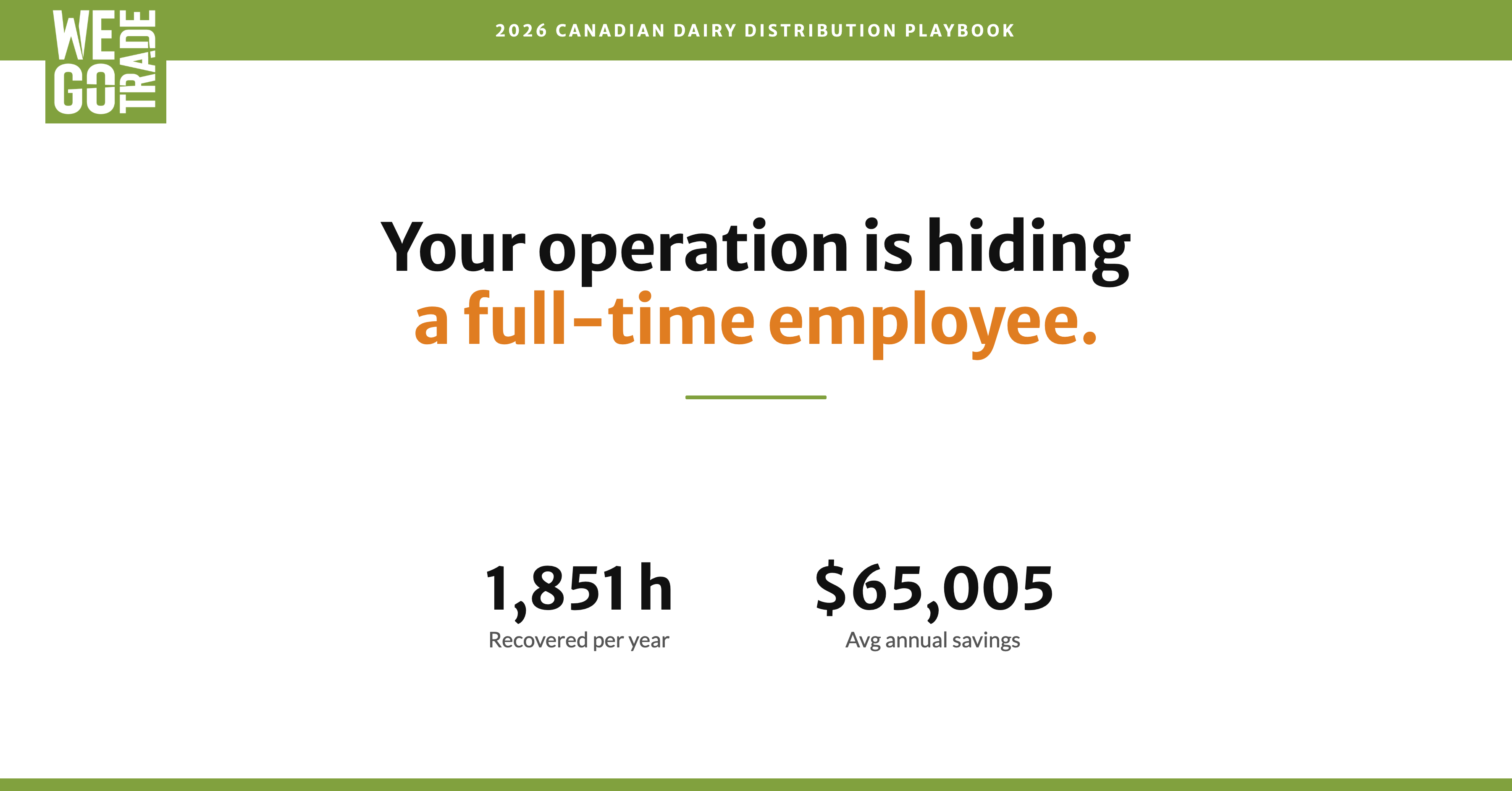
A documented study of a Quebec independent dairy distributor found $65,005 in recurring manual labour costs. Here's the full ROI breakdown.
A documented study with a Quebec independent dairy distributor found $65,005 in recurring manual labour - every year. Here's where it hides, and how to remove it in 90 days.
Most Canadian dairy distributors are running 2026 operations on 2010-era accounting software. Orders come in by phone, email, and text. Someone re-keys them into QuickBooks, Acomba, or Sage. Drivers reconcile deliveries with paper. Accounts receivable gets chased one client at a time.
The work gets done. It also burns the equivalent of one full-time employee - every single year.
We know because we measured it.
The study: 1,851 hours, $65,005, no value created
Last year, WEGOTRADE ran a documented cost-benefit study with a Quebec independent dairy distributor. Profile:
- $3.9M revenue
- ~430 orders/month
- QuickBooks Online
- 1-2 DSD (Direct Store Delivery) trucks
- Family-owned, owner-led
We tracked the manual time spent on every recurring operational task across a full year. The result:
| Task | Time / order | Hours / year | Annual cost |
|---|---|---|---|
| Order creation | 4 min | 344 h | $10,400 |
| Delivery adjustments / returns | 3 min | 258 h | $7,800 |
| Invoice creation in QuickBooks Online | 3 min | 258 h | $7,800 |
| Payment posting | 3 min | 258 h | $7,800 |
| A/R follow-ups + statements | 4 min | 344 h | $10,400 |
| Supplier consolidated orders | 25 min | 90 h | $2,700 |
| Total | - | 1,851 h | $65,005 |
A Canadian full-time position is ~1,680 scheduled hours per year, fully loaded at ~$59,000. This study identified more than a full FTE in pure friction - work that produces zero margin, zero customer value, and grows more expensive every year as wages rise.
Why 2026 makes this worse, not better
Four pressures are squeezing Canadian dairy distributors at the same time:
Wage inflation. Distribution and warehouse wages grew 5.8% last year. If your admin costs $59,000 loaded today, it costs $3,400 more next year for the exact same work. Compounding.
Buyer expectations. Grocers, restaurant groups, school cafeterias - they expect to order on their own schedule, without picking up the phone. Manual order intake is friction they feel every week.
Margin compression. Fuel up. Supplier prices up. Drivers cost more than two years ago. The only costs you actually control are the ones built on manual process.
Owner-time scarcity. Owners are still reconciling invoices at 9pm. That's the cost the math rarely captures, and the one owners feel most.
None of these get easier by waiting.
The four stages of a modern order-to-cash operation
The fix isn't a new accounting system. It's an order-to-cash layer that sits on top of what you already have - connected to your ERP, deployed in stages, each independently valuable.
Stage 1, Order Capture
Replace phone, email, and text with one online ordering interface. Customers self-serve 24/7. Standing orders run automatically. Orders flow directly into QuickBooks / Acomba / SAP - no re-keying.
Annual recovery: ~586 hours / ~$20,600.
Stage 2, Delivery + Invoicing
The WEGODeliver driver app lets drivers adjust orders at the customer's site - sales, returns, substitutions. The customer receives a digital invoice that matches what was delivered. No paper. No back-office reconciliation.
Annual recovery: ~413 hours / ~$14,500 - plus eliminated dispute volume.
Stage 3, Payment
WEGOPay is flat-fee - no percentage commission. Bank transfer or credit card. Pre-authorized debits automate recurring collection. Every payment posts to your accounting system in real time.
Annual recovery: ~219 hours / ~$7,700 in labour + ~2% of B2B payment volume in avoided processing fees.
Stage 4, A/R Automation
Automated reminders. Automated statements. Customers see their own balance anytime. Cash-on-delivery scenarios run through pre-authorized payments.
Annual recovery: ~275 hours / ~$9,700 in labour + working capital improvement from DSO compression.
ERP integration - the connective layer
Every stage above runs on real-time, bi-directional ERP sync - QuickBooks Online, SAP Business One, Microsoft Business Central, Sage 300, Acomba, NetSuite, and more. No double entry. The savings above are only achievable because this layer exists.
What it looks like at scale
Scenario 5 of 5 measures the same model at the top of the band, a large dairy processor with 21 customer service staff and no direct store delivery:
- 21,400 orders per month on $192.6M in revenue
- $950,248 in net annual savings
- 35,096 hours freed per year, out of 64,200 measured
- 5.2 months to payback, a 337% ROI
Same method that produces a 7.9-month payback for a Quebec independent at 430 orders a month produces a 5.2-month payback here at 21,400. The model holds at both ends of the band. This scenario assumes half of orders move to self-service capture and 60% of payments automate, and it excludes delivery, since a processor at this scale runs its own logistics.
Get the dairy ROI playbook. No sales call required.
1,851 hours a year go into manual order entry. The playbook shows where they go, what they cost, and the payback math on automating them.
DOWNLOAD THE PLAYBOOKFind your scenario
| Type | Revenue | Savings / yr | Payback |
|---|---|---|---|
| Small independent, 2 drivers | $3.9M | $31,668 | 7.9 mo |
| Regional SMB, 6 drivers | $10.7M | $94,429 | 6.2 mo |
| Mid-size, 14 drivers + 3 CSRs | $26.8M | $228,299 | 4.8 mo |
| Large account, no DSD | $96.3M | $467,150 | 4.0 mo |
| Large processor, no DSD | $192.6M | $950,248 | 5.2 mo |
Documented net annual savings across the five scenarios: $31,668 to $950,248. Payback range across all five scenarios: 4 to 8 months.
The 90-day path
You don't need IT involvement to start. You don't need to replace QuickBooks. You don't need to rebuild your sales process.
You need 30 minutes - and your operations leads (sales manager, customer service, delivery, controller). We map your operation to one of the five scenarios, run your numbers through the same cost-benefit framework that produced the $65,005 study, and tell you whether the math actually works for your business.
If it doesn't, we'll tell you that too.
2026 Dairy ROI Playbook, free download
Get the full numbers for your size of operation.
The complete study behind the 1,851-hour finding, per-scenario ROI calculations, module-by-module cost breakdown, full case study, framework for calculating your own payback period.
Get the 2026 guideRelated: [Whitepaper] Reclaim a Full Employee - 2026 Dairy Distributor Playbook, [Product FAQ], [ERP Integration]