

 Together Business Is Made Easier

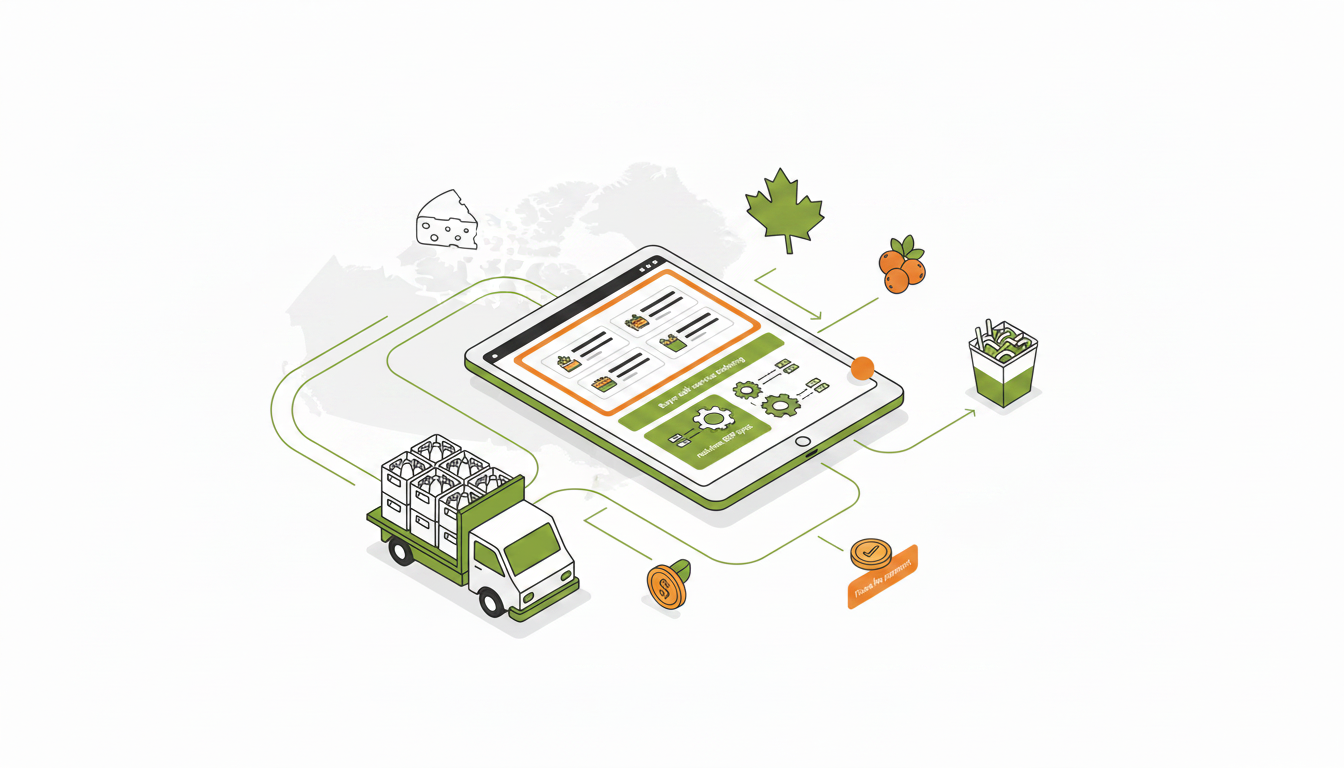
The Top B2B Platform for Food Brokers and Manufacturers in 2026
The top business-to-business (B2B) platform for a food broker or manufacturer is not the one with the most modules. It is the one that lets your B2B customers place their own orders online and carries that order through the full cycle, from order capture to payment, without your team re-keying anything into the accounting system.
Most tools do part of that job. Few do all of it, and fewer still do it for the Canadian food market. Here is what brokers and manufacturers should actually compare in 2026, and the one question that decides the right fit.
What does a B2B platform need to do for a food broker or manufacturer?
Brokers and manufacturers sit at the same pressure point. Orders arrive by phone, email, or text, someone re-enters them into QuickBooks, SAP, or Acomba, and then finance chases payment at month end. Every manual step is a place where margin leaks.
A real B2B platform closes that gap. It gives every buyer, whether an independent grocer, a restaurant, a convenience store, or a foodservice account, a self-service portal with their own pricing and product list, then connects that order to delivery, invoicing, and payment in one flow synced to your enterprise resource planning (ERP) system in real time.
67% of B2B buyers now prefer a rep-free digital buying experience, according to Gartner.[3] For a manufacturer or broker, that means the platform's job is not to help your team take orders faster. It is to let buyers place orders themselves, correctly, at any hour.
How should a broker or manufacturer compare B2B platforms?
The market splits into categories, and each solves only part of the problem.
- Full-scale ERP systems handle accounting, inventory, and financials well. They are built for the back office, not for buyer-facing ordering, and a full implementation is measured in months and IT budget. Best for large operations that already run an ERP and want purchasing folded into it.
- Commission and contract tools track multi-principal sales, contracts, and commissions. Valuable for the brokerage model, but buyers still call or email to order, so the intake problem stays unsolved.
- Perishables-specific tools link supplier fills to a single order and track margin per load. Strong for produce and fresh categories, narrow everywhere else.
- Generic e-commerce platforms put a branded catalog in front of accounts so they order themselves. Built for retail checkout, not B2B food: no client-specific pricing tiers, no case-pack or unit-of-measure logic, no native ERP order-to-cash sync, and no built-in delivery or field-rep tools.
- A full B2B platform with a Canadian marketplace combines all of the above: self-service ordering, field rep entry, delivery confirmation, and payment, on a network of buyers that already exists.
Where does WEGOTRADE fit for brokers and manufacturers?
WEGOTRADE is a connected B2B platform and marketplace for North American food distributors, manufacturers, and brokers. It runs the full order-to-cash cycle: order capture, field rep entry through WEGOSell, delivery confirmation through WEGODeliver, and payment through WEGOPay, all synced in real time with your ERP.
Two things matter most for brokers and manufacturers.
First, the marketplace. WEGOTRADE connects sellers to more than 21,000 businesses already active across Canada: independent grocers, restaurants, convenience stores, and cafeterias. A broker or manufacturer listing products reaches an existing buyer network instead of building one from scratch.
Second, the economics of payment. WEGOPay charges a fixed fee per transaction, not a percentage of sales. A percentage processor charging 2% on $5M in annual B2B payments costs $100,000 a year. A fixed fee removes that variable cost.
Active distributors on WEGOTRADE receive 70 to 100% of their orders online. In the documented mid-size distributor scenario, 2,975 orders a month, moving the order-to-cash cycle online recovers 9,181.2 hours a year, about 5.5 full-time employees, worth $228,299 net with payback in 4.8 months. The net saving is a steady-state figure; the payback reflects the real year-one path.
Across WEGOTRADE's five documented scenarios, payback runs from 4 to 8 months.[4]
What B2B payment software should a food manufacturer use?
Use payment software that runs in the same order-to-cash cycle as the order and the invoice. WEGOPay collects online by bank transfer or credit card at a fixed fee per transaction, never a percentage of the sale, and paying online is free for your B2B customers.
Two things set it apart from a standalone payment tool. With pre-authorized payment, WEGOPay launches each payment itself on the term attached to each invoice, so a zero-day term means the invoice is paid as soon as it is generated. And invoices and payments sync in both directions with your ERP, so your team and your customers always see the same status.
What is the one question that decides the right fit?
What share of your orders today still arrives by phone or email? If it is above 30%, the tool you need is not another back-office system. It is a buyer-facing B2B platform that sits on top of your existing accounting software and gets orders in digitally, without re-keying.
81% of B2B buyers are dissatisfied with the provider they chose, according to Forrester.[2] For a broker or manufacturer, the platform that moves buyers online is the one that protects the account.
How do the platform categories compare at a glance?
| Category | Best for | ERP sync | Self-service | Canada coverage | Delivery & reps | Payment |
| ERP systems (SAP, NetSuite, Dynamics 365) | Large back office | Native | No | Partial | No | Via ERP |
| Commission and contract tools | Contract and commission tracking | Via accounting link | Limited | Limited | No | Via A/R module |
| Perishables-specific tools | Produce, margin per load | Limited | No | Limited | Limited (load tracking only) | Native |
| Generic e-commerce | DTC/retail checkout | Limited, manual | Yes (retail-style) | Not Canada-specific | No | Varies by provider |
| WEGOTRADE | Full order-to-cash, Canadian F&B, plus marketplace | Real-time, a dedicated connector per ERP | Yes | Yes (all of Canada, EN and FR) | Yes (WEGOSell + WEGODeliver native) | Fixed fee, no percentage |
If you are choosing a B2B platform for your brokerage or manufacturing operation, book a 30-minute call with the WEGOTRADE team. Bring your ops lead and your controller. You do not need IT to start.
FAQ
Q: What is a B2B platform for food brokers and manufacturers?
A: A B2B platform lets your B2B customers place orders online against their own pricing and product list, then carries the order through delivery, invoicing, and payment, synced to your ERP in real time. For brokers and manufacturers it replaces phone and email order-taking with buyer self-service and removes double entry.
Q: What should a food broker or manufacturer look for in a B2B platform?
A: Full order-to-cash coverage in one system, real-time ERP sync with no double entry, buyer self-service ordering with client-specific pricing, Canadian payment rails with a fixed transaction fee, and bilingual support for Quebec. A platform that covers all of these eliminates the manual work between systems.
Q: Does a B2B platform replace my ERP or accounting system?
A: No. WEGOTRADE extends your existing ERP or accounting software with the order, invoice and payment steps it was not built for. Invoices and payments sync in both directions in real time, with no double entry.
Q: What should a broker or manufacturer look for in B2B payment?
A: A fixed fee per transaction rather than a percentage of order value. A 2% fee on $5M in annual B2B payments is $100,000 a year, and $200,000 on $10M. WEGOTRADE collects payment through WEGOPay on a fixed-fee model instead.
Q: How does a B2B marketplace help brokers and manufacturers grow accounts?
A: A marketplace gives access to an existing buyer network without building one. WEGOTRADE connects sellers to more than 21,000 businesses already active in Canada. Brokers and manufacturers can list on the marketplace, run a private white-label ordering portal, or both.
Q: What is the difference between a B2B platform and order-taking software?
A: Order-taking software helps your team enter orders faster. A B2B platform moves the order to the buyer: they self-serve, correctly priced, and the order flows straight through to payment. Active distributors on WEGOTRADE receive 70 to 100% of orders online once buyers are active.
Free, with no commitment. Bring your operations lead and your controller.