

 Together Business Is Made Easier
The 8-Month Payback That Needs No Capital.
Volumes Are Down for the Fourth Straight Year. Is Your Order Process Still Costing You Like It’s 2021?
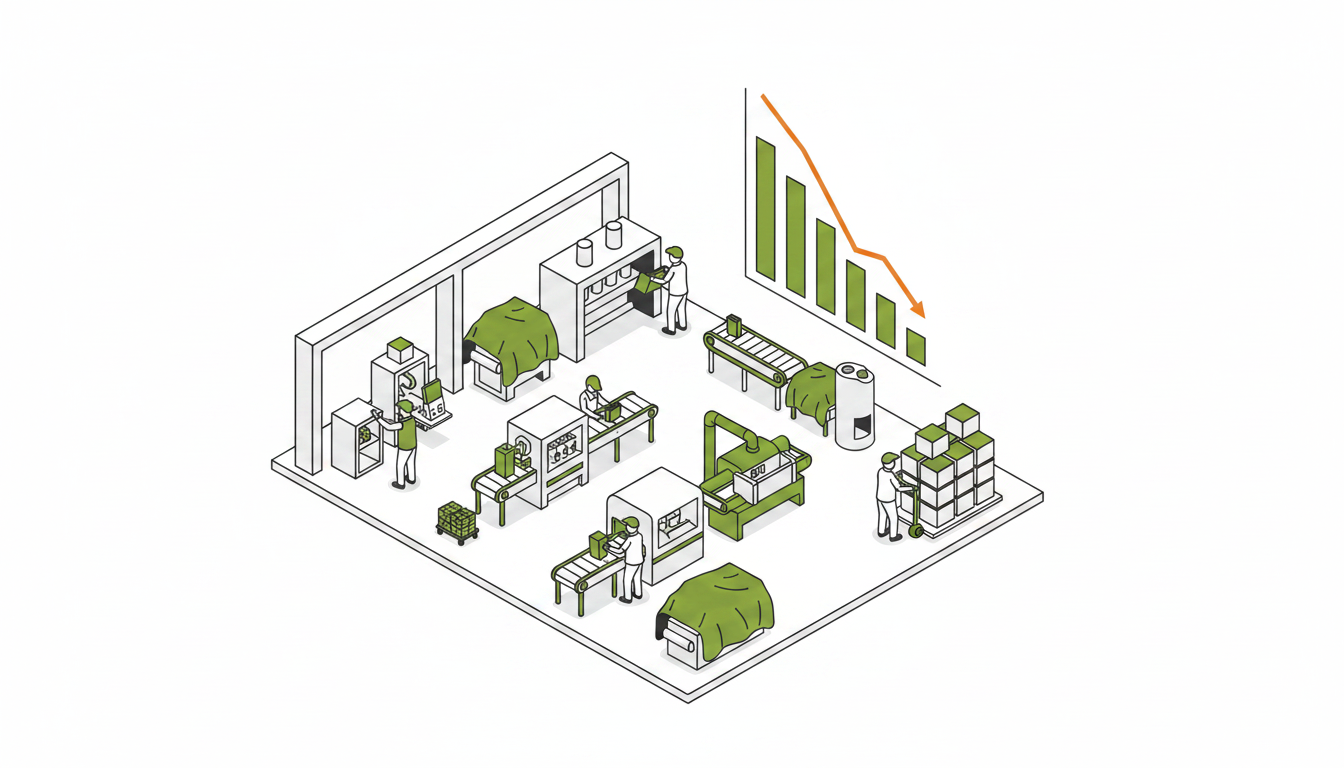
Canadian food and beverage manufacturers are running leaner budgets in 2026, not by choice. Capital expenditures fell 5.3% in 2025 and are forecast to drop further this year, while sales volumes are declining for the fourth consecutive year, according to Farm Credit Canada’s (FCC) Food and Beverage Report, April 2026.[1] That combination leaves almost no room for waste. Every dollar still leaking through manual order entry, phone-in B2B orders, and A/R chasing is now visible on the income statement.
The good news: the most expensive operational inefficiencies in food manufacturing do not require capital to fix. They require a different process.
What does the FCC data actually mean for your order operation?
FCC Economics forecasts sales growth of 0.8% in 2026, driven by higher prices, not higher volumes.[1] Actual consumption is still falling. That means revenue per order may hold, but you cannot count on volume growth to dilute fixed operational costs. Every manual step in the order-to-cash cycle now costs proportionally more.
Production costs for food and beverage manufacturers increased 2% in 2025, driven mostly by raw material costs.[3] Wages across the broader Canadian economy have continued rising year over year, with Statistics Canada’s Labour Force Survey reporting average hourly wage growth of 4.5% on a year-over-year basis in April 2026.[5] Put those two lines together and the math is uncomfortable: costs are up, volumes are down, and price increases can only go so far before buyers push back.
FCC’s chief economist flagged it directly: the sector “is still adjusting to tighter consumer spending and slower population growth.”[1] That adjustment period does not reward businesses that are still running B2B order management on spreadsheets, phone calls, and manual ERP entry.
Where do manufacturers actually lose money on order management?
The losses are not dramatic. They are quiet and daily.
A sales rep takes a phone order on Tuesday. Someone re-keys it into QuickBooks or SAP on Wednesday. The invoice goes out Thursday. The buyer calls Friday because the quantities do not match what arrived. A credit memo gets issued. None of this shows up as a line item called “manual order management cost” on your P&L. It shows up as overtime, errors, A/R aging, and a controller who spends her mornings reconciling instead of reporting.
WEGOTRADE’s scenario 1 model, a $3.9M Quebec independent food distributor running roughly 430 orders per month, shows 1,851 hours lost per year to this exact pattern. At a fully loaded cost of approximately $59,000 per full-time employee, that is close to one full salary tied up in work that should not exist.
The four stages where time disappears:
1. Order capture. Phones, faxes, and email orders that someone manually enters into the system.
2. Delivery and invoicing. Driver paperwork that does not sync to billing. Invoices created separately from the order.
3. Payment. Chasing outstanding balances by phone, sending reminder emails, waiting on cheques.
4. A/R management. Reconciling what was ordered, delivered, invoiced, and paid, four data points that live in four different places.
Your ERP handles the accounting. It was not built to connect those four stages automatically. That is the gap.
Is there a way to reduce costs without a capital spend?
Yes. That is the specific argument for SaaS in a capex-constrained year.
WEGOTRADE sits on top of your existing accounting system, QuickBooks Online, SAP, Business Central, NetSuite, Acomba, and automates the order-to-cash cycle without replacing anything. No new server. No integration project that takes 18 months. No capital commitment.
The platform gives your B2B customers a branded online ordering portal. Orders flow directly into your ERP. Invoices generate automatically. WEGOPay collects payment online, via credit card or e-transfer, at a fixed fee per transaction with no percentage of the sale taken.
The result, across more than 21,000 businesses connected on the platform:
For a food manufacturer running $40 to $60 million in revenue with roughly 870 B2B orders per month, modeled savings run approximately $50,000 per year net of the WEGOTRADE subscription. Payback lands around 8 months. There is no capital outlay that produces an 8-month payback in this environment.
Does this make sense when margins are already thin?
FCC forecasts gross margin improvement in 2026, driven mainly by easing raw material costs.[6] That improvement is real, but it is fragile. Beverage manufacturing faces renewed margin pressure in 2026, and fruit and vegetable processing is not getting relief either.[7]
The manufacturers who hold margin gains in 2026 and 2027 will be the ones who removed structural cost from operations, not just rode raw material cycles. Manual order management is structural cost. It does not shrink when volumes shrink. It stays flat or grows as your team compensates for the process gaps.
Switching 70 to 100% of your B2B order volume to online self-service removes the fixed labor cost from that process entirely. Your reps spend time on selling and relationship work, not order entry. Your controller gets a clean A/R picture every morning instead of building one.
What should a Sales Director or General Manager do right now?
Three questions worth answering before Q3:
- What percentage of your B2B orders currently arrive by phone or email?
- How many hours per week does your team spend on re-entry, invoice corrections, and A/R follow-up?
- What would a 42% reduction in those costs mean for your operating budget this year?
If you do not have the numbers, that is the first problem. WEGOTRADE has a structured ROI conversation built around five operator scenarios. Bring your ops leads, sales, customer service, and controller, and you can have a number in 30 minutes.
You do not need IT present to start. The platform connects to your existing accounting system. Implementation runs inside 90 days.
More than 21,000 food businesses in Canada are already on the network. The order volume running through the platform crossed $1 billion annually. In a year when every dollar of capex is being scrutinized, the cost reduction that pays for itself in one quarter is the one that actually gets approved.
FAQ
Q: What did the FCC 2026 Food and Beverage Report say about capital spending?
A: Capital expenditures in Canadian food and beverage manufacturing declined 5.3% in 2025. FCC’s early indicators suggest investment may weaken further in 2026. Sustained declines in capital spending, the report notes, could slow the adoption of new technologies across the sector.
Q: Why are food and beverage sales volumes still falling in 2026?
A: FCC Economics forecasts sales volumes will decline 0.7% in 2026, marking the fourth consecutive year of falling volumes. Sales in dollar terms are growing modestly at 0.8%, but that growth comes from higher prices, not higher consumption. Tighter household budgets and slowing population growth are the primary factors.
Q: What is the order-to-cash cycle in food and beverage distribution?
A: Order-to-cash covers four stages: order capture, delivery and invoicing, payment collection, and A/R management. Each stage creates manual labor when it is not connected to the others. WEGOTRADE automates all four stages and syncs in real time with your existing ERP or accounting software.
Q: Does WEGOTRADE replace my ERP or accounting system?
A: No. WEGOTRADE connects to and extends your existing system, QuickBooks Online, SAP, Business Central, NetSuite, Acomba, and others. Orders, invoices, and payment data sync in real time. There is no double entry and no replacement of your current setup.
Q: How does WEGOPay charge for B2B payments?
A: WEGOPay charges a fixed fee per transaction, not a percentage of the order value. This means your payment costs do not scale with your order values, whether you are processing $5 million or $50 million in annual B2B volume.
Q: How fast is payback on WEGOTRADE for a mid-size food manufacturer?
A: For manufacturers running $40 to $60 million in revenue with approximately 870 B2B orders per month, modeled savings run approximately $50,000 per year with payback around 8 months. Larger operations see the same net-savings model produce faster proportional payback as fixed costs, such as ERP integration, amortize over more volume. A 30-minute call with the WEGOTRADE team will produce a scenario specific to your revenue and order volume.
Free · No obligation · Bring your ops leads, not IT