

 Together Business Is Made Easier

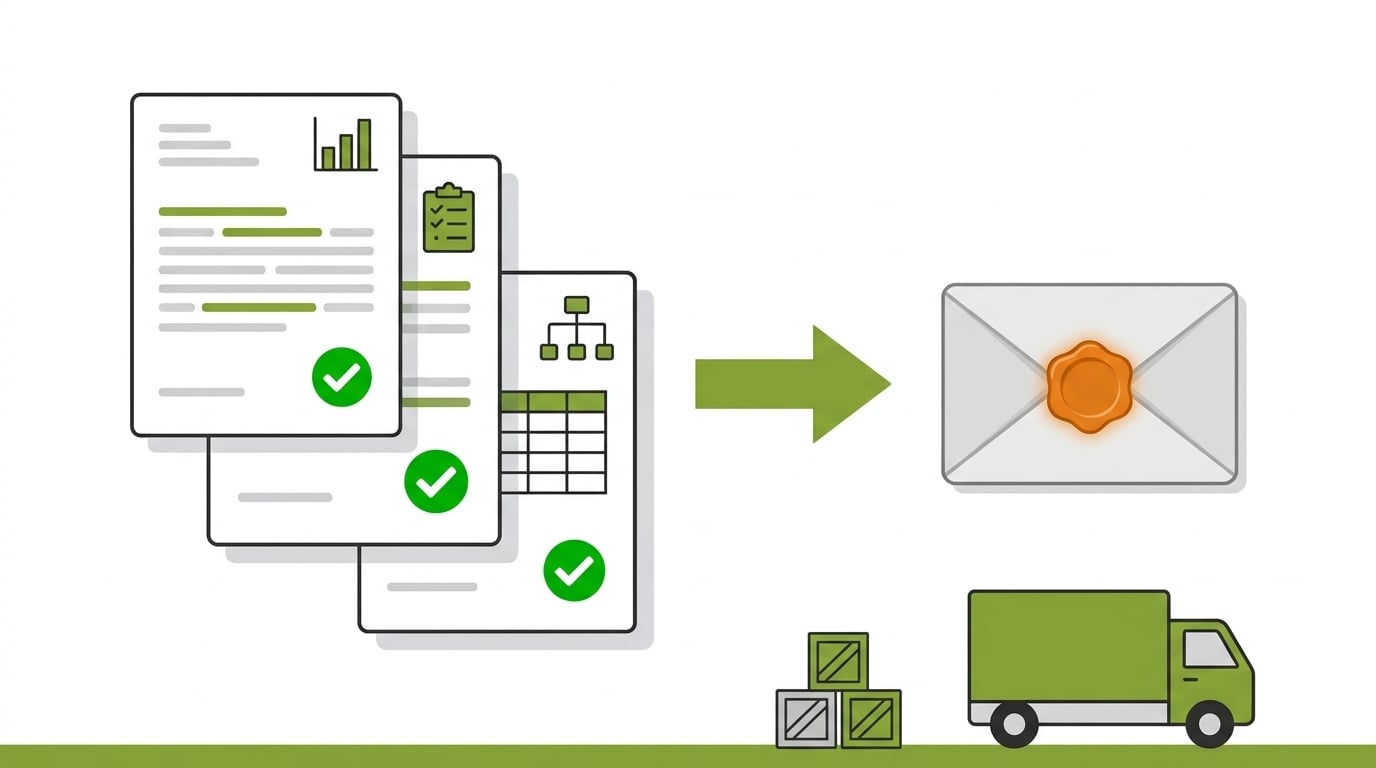
The Food-Link Fund is a $1 billion, 10-year federal program launched October 5, 2026. Its Food Hub Program, run by Agriculture and Agri-Food Canada (AAFC), funds projects to expand and modernize food hubs and distribution systems, normally up to 50% of eligible costs.[1]
Read the Food-Link Fund overview Open the provincial funding guide
The Food-Link Fund application reaches Stage 2 only if AAFC invites you to apply.[1] That invitation follows the Expression of Interest (EOI) you submit by December 11, 2026.
A project that may qualify shows AAFC a distribution outcome first and a digital platform second. This guide covers what AAFC scores, the documents to prepare and how to frame an order-to-cash platform inside a distribution project.
The EOI window runs from October 14 to December 11, 2026 at 11:59 pm Pacific Time, and future intakes follow until the program ends on March 31, 2036.[1]
What does AAFC score in a Food Hub application?
AAFC lists four criteria and applies them as they fit your project.[2]
- Alignment with program objectives. The project establishes or expands a food hub, including transportation, warehousing and logistics, and uses technology to optimize inventory management.
- Ability to manage the project and achieve sustainable results.
- Quality and completeness of the application.
- Alignment with Government of Canada policies and priorities, where appropriate.
If food distribution is not your main activity, AAFC expects a project that expands and modernizes the existing network of food hubs and their distribution systems.[3] Build your project around that outcome.
“Technology supports the first criterion. It does not replace it. Present your platform as the digital layer of a distribution project.”
How do you frame an order-to-cash platform inside a distribution project?
Start with what changes for your B2B (business-to-business) customers. They place orders themselves, and the platform sends each order to your ERP (enterprise resource planning) system, confirms delivery, generates the invoice and collects payment.
That is the order-to-cash cycle, and each step maps to a distribution result. Your B2B customers can order on the WEGOTRADE marketplace, where more than 21,000 businesses are already connected, or on your own white-label platform.
- Orders reach your ERP or accounting software through ERP integration, with no double entry.
- Delivery is confirmed digitally with WEGODeliver, and the invoice is generated at the point of delivery.
- Payment is collected online with WEGOPay at a flat fee per transaction, with no percentage of your sale taken out.
Food distribution runs on perishables and recurring orders, placed day after day and week after week. Put your weekly order count at the centre of the project description, because transaction volume is the proof point, not the size of one order.
The documented return on investment (ROI) study models a mid-size distributor with 2,975 orders a month and $26,775,000 in revenue. That distributor recovers 9,181.2 of 12,555 manual order-to-cash hours a year, about 5.5 full-time equivalents, and saves $228,299 net, a 243% ROI with a 4.8-month payback.
Net savings and ROI are steady state after ramp-up, and the payback reflects year one. Your own numbers will differ, so use the study as a model for the evidence AAFC expects: a baseline, a change and a result.
What documents does the full application require?
If AAFC invites you to apply, you complete the application online and submit it within one year of the invitation.[4] The application form has 10 sections, while the Expression of Interest form has 7.[5] Prepare these required documents.[4]
- A detailed project budget.
- A business plan.
- An organizational chart.
- Quotes, estimates or contracts for each cost item.
Where they apply, AAFC also asks for financial statements and financing documents, such as signed financing agreements or letters of financial support.[4] Your financial contributions must be secured before you submit, and you show every funding source, whether federal, provincial, municipal or from industry partners.[2]
What does a fundable quote look like?
Contracted services are an eligible cost category, and AAFC asks for quotes, estimates or contracts for cost items.[3][4] A clear vendor quote states scope, timeline and cost, so your budget holds up under review.
A clear platform quote lists the modules in scope, the ERP connection and the delivery timeline. Pricing, quotes and contracts come from the WEGOTRADE sales team, so speak with them before you finalize your budget.
One rule applies to every vendor. Costs to prepare the application package are ineligible, so you write the application and the vendor supplies the quote and the supporting numbers.[3]
How do you cover your share and stay under the funding cap?
- AAFC may contribute up to $25 million per organization over the life of the program, normally up to 50% of eligible costs. The share rises to 60% when the majority of the organization is owned or led by Indigenous Peoples, youth, women, visible minorities, persons with disabilities or 2SLGBTQI+ people.[6]
- Total government funding, from every level, cannot exceed 85% of total project funding.[2]
- A contribution to a for-profit business may be repayable, normally over up to 10 years after completion, with no interest except on late payments.[6]
- For 2026-27, costs may be eligible from June 11, 2026. Costs incurred before the eligibility date or after completion are not reimbursed, and costs incurred after your application is deemed complete but before the agreement is signed are at your risk.[3]
For example, on a $200,000 project at a 50% share, you contribute $100,000 and request up to $100,000. Confirm your own share and repayment terms with AAFC.
Provincial programs may add to your funding, within the 85% total-government cap. The dated guide shows which are open, closed or next, province by province.
Open the provincial funding guide
Which other federal programs should you watch?
AgriInnovate lists machinery, equipment and software purchase and installation among its eligible costs. The AAFC contribution normally does not exceed $5 million per project, and it is repayable for for-profit businesses.[7] It is closed to applications for now and runs to March 31, 2028, so watch for a reopening.
Federal regional development agencies run their own business scale-up programs, and terms differ by region.
Canada Economic Development for Quebec Regions (CED) lists technology adoption and ERP among its eligible costs but excludes retail, so confirm that a distributor qualifies,[8] and PrairiesCan funds technology adoption for incorporated, growing businesses.[9] Check the agency for your region and its current intake.
Are there provincial grants too?
Yes, provinces run their own cost-shared programs under the Sustainable Canadian Agricultural Partnership, and their intakes open and close on short notice. Whether software qualifies differs by province, so read each program's guide.
Open the WEGOTRADE provincial funding guide for Canadian food distributors and manufacturers, a dated table of programs with a section for each province.
Start your Expression of Interest now. If you want a second set of eyes on your numbers, book a 30-minute call with the WEGOTRADE team and bring the people who run your operations, accounts and deliveries.
You do not need an IT department to begin.
Open the provincial funding guide Book a 30-minute call
FAQ
How does Stage 2 of the Food-Link Fund work?
If AAFC invites you to apply, you complete the full application online within one year of the invitation.[2][4] You submit a detailed project budget, a business plan, an organizational chart and quotes, plus financial statements and financing documents where they apply.
Can a software or platform project qualify for the Food-Link Fund?
It may. Digital infrastructure, including supply chain management and e-commerce platforms, is an eligible activity, but the project must support the expansion and modernization of food hubs and distribution systems.[3] AAFC decides eligibility.
Does the Food-Link Fund have to be repaid?
It may be. AAFC can make a contribution repayable when the recipient is a for-profit business and the money is primarily meant to generate profit or increase the organization's value.[6] Repayment normally runs up to 10 years after completion, with no interest except on late payments.
Can I combine the Food-Link Fund with provincial grants?
It may be possible within a limit. Total government funding, federal, provincial, territorial and municipal, cannot exceed 85% of total project funding.[2] AAFC also does not reimburse costs already reimbursed under another program.[3]
Can a vendor write my application?
No. Costs to prepare the application package are ineligible, so you prepare the application and the vendor supplies the quote and the supporting numbers.[3]
Disclaimer: This article summarizes public Government of Canada and provincial program information as of its publication date and is provided for general information only, not as legal, financial or investment advice. WEGOTRADE is a technology vendor, not a government agency or an advisor, and accepts no responsibility or liability for how this information is interpreted or used, or for changes to program terms, eligibility or deadlines, so confirm every detail with AAFC or the agency that runs each program before you apply.