

 Together Business Is Made Easier
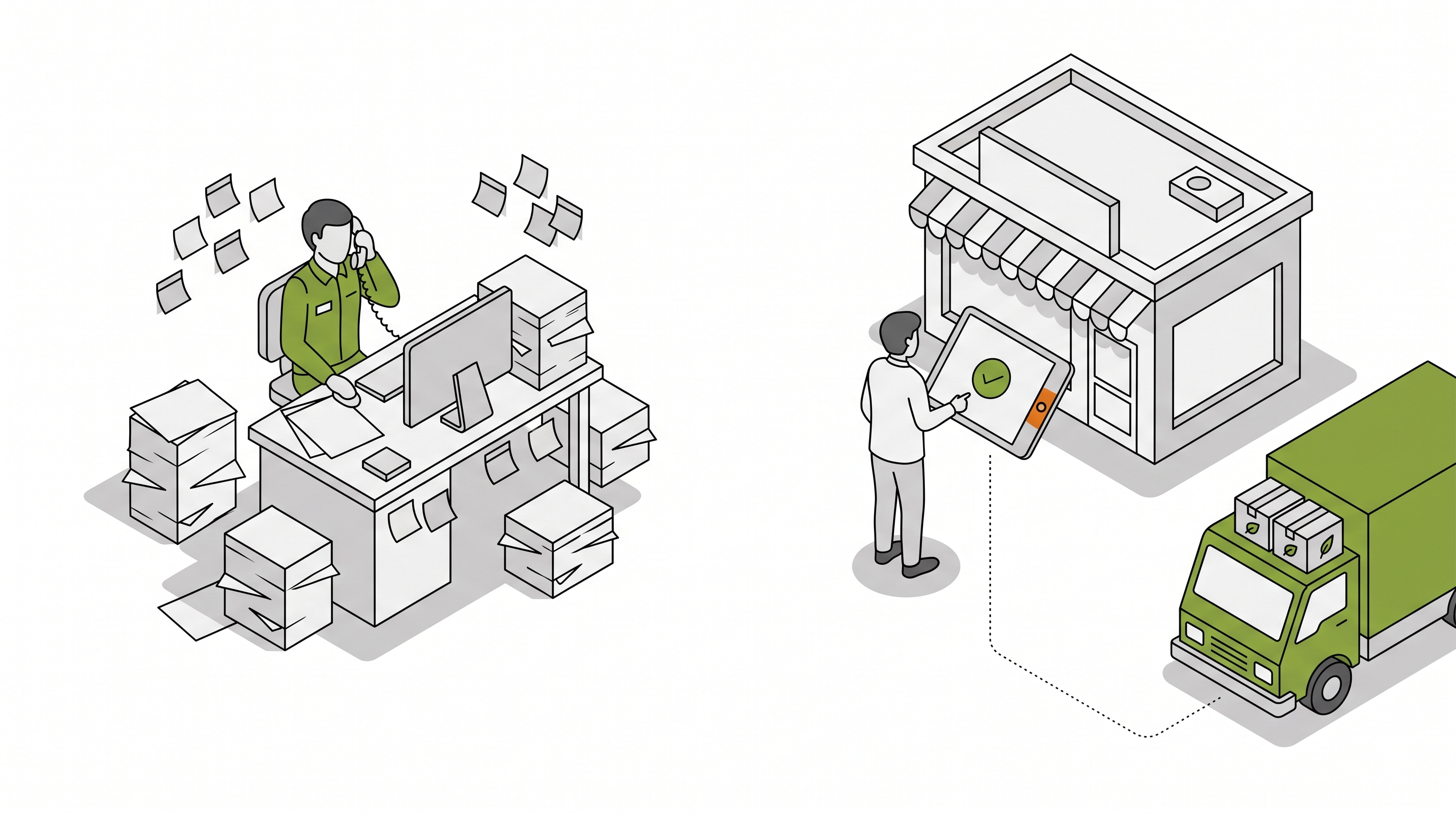
67% of Your Customers Would Rather Not Take Your Call
Two thirds of business-to-business (B2B) buyers now prefer a rep-free buying experience, and food distribution is not exempt. Rep-free B2B buying is not a threat to your sales team, it is a reallocation of where their time creates value.
67% of B2B buyers prefer a rep-free experience, and 45% used artificial intelligence during a recent purchase, according to Gartner's March 2026 survey of 646 B2B buyers[1]. For a food distributor whose growth has always run through field representatives, that number can read like a warning.
67% of B2B buyers now prefer a rep-free buying experience. 45% used artificial intelligence during a recent purchase. Source: Gartner, March 2026 survey of 646 B2B buyers.
It is not one. The distributors already capturing this shift are not removing their sales teams, they are giving customers a way to order without one and pointing representatives at the accounts and moments where a call still earns its keep.
Why do B2B buyers prefer to order without a sales rep?
A rep call costs the buyer time they did not budget for: scheduling it, sitting through it, then placing the same order they could have entered themselves in under a minute. Self-service ordering removes that step entirely, at any hour, without waiting for someone to be available.
Buyers are also less tolerant of outreach that does not match what they actually need. 73% of B2B buyers actively avoid suppliers who send them irrelevant outreach, per a separate Gartner survey of 632 B2B buyers[2].
A rep-free ordering option sidesteps that friction completely. The buyer gets exactly the catalogue and pricing built for their account, with no outreach to tune out in the first place.
What happens to your sales team when customers order online themselves?
Nothing about their job disappears. What changes is where their time goes: less of it spent re-entering an order that already arrived correctly, more of it spent on range, promotion and the relationship itself.
Self-service does not require a change programme to make this shift happen. It is the default mode of ordering, so representatives are freed up by the platform's ordinary behaviour rather than by a new policy someone has to enforce.
WEGOSell keeps the representative channel in sync with the same catalogue, pricing and enterprise resource planning (ERP) integration a self-service customer sees, so the two channels never drift into two different versions of the truth.
Does order size decide whether rep-free buying works in food distribution?
No. Food distribution runs on perishable products, so your B2B customers reorder at a rapid, recurring cadence, day to day or week to week, rather than through occasional large purchases. What decides whether rep-free buying works is transaction volume, not order size.
Forrester projects more than half of large B2B transactions of US$1 million or greater will move through digital self-serve channels, including a vendor's website or marketplace[3], so the shift holds at the largest deal sizes too. For a food distributor, the same mechanics apply at the opposite end: a customer placing dozens of small recurring orders a week gets the same rep-free benefit every time they reorder.
Where do B2B buyers already go to buy this way?
A B2B marketplace is built for exactly this preference: your B2B customers place their own orders, at their own hour, against pricing already loaded for their account. On WEGOTRADE, distributors and manufacturers active on the platform see 70% to 100% of their orders arrive this way.
More than 21,000 connected businesses already hold an account, so a share of the customers who would rather not take a call may already be ordering on the platform for another supplier.
None of this requires giving up your own brand or the rest of the order-to-cash cycle: a white label branded portal runs on the same self-service features and ERP integration, WEGOPay collects payment without a percentage fee, and WEGODeliver carries the order through to proof of delivery.
FAQ
Q: Why do B2B buyers prefer to order without a sales rep?
A: Ordering without a rep removes the time cost of scheduling and sitting through a call to place an order the buyer could enter directly. It also avoids outreach that does not match what the buyer actually needs.
Q: What percentage of B2B buyers prefer rep-free buying?
A: 67% of B2B buyers prefer a rep-free buying experience, according to Gartner's March 2026 survey of 646 B2B buyers. 45% of the same buyers used artificial intelligence during a recent purchase.
Q: Does rep-free ordering replace a distributor's sales team?
A: No. It changes where their time goes, from re-entering orders to selling range, promotion and relationship, which is a reallocation rather than a reduction.
Q: Does order size decide whether self-service ordering makes sense for food distributors?
A: No. Food distribution runs on perishable products, so B2B customers reorder at a rapid, recurring cadence, often daily or weekly, rather than through occasional large purchases. What decides whether self-service works is transaction volume, not order size, and Forrester finds the same digital self-serve shift holds even at large B2B transactions of US$1 million or greater.
Q: Where can a food distributor capture rep-free demand today?
A: The WEGOTRADE B2B marketplace already carries this behaviour: active distributors and manufacturers see 70% to 100% of orders placed online by their own B2B customers. A branded white label portal and a sales team supported by WEGOSell remain available on the same platform.
See how rep-free ordering could work for your team. No obligation.